
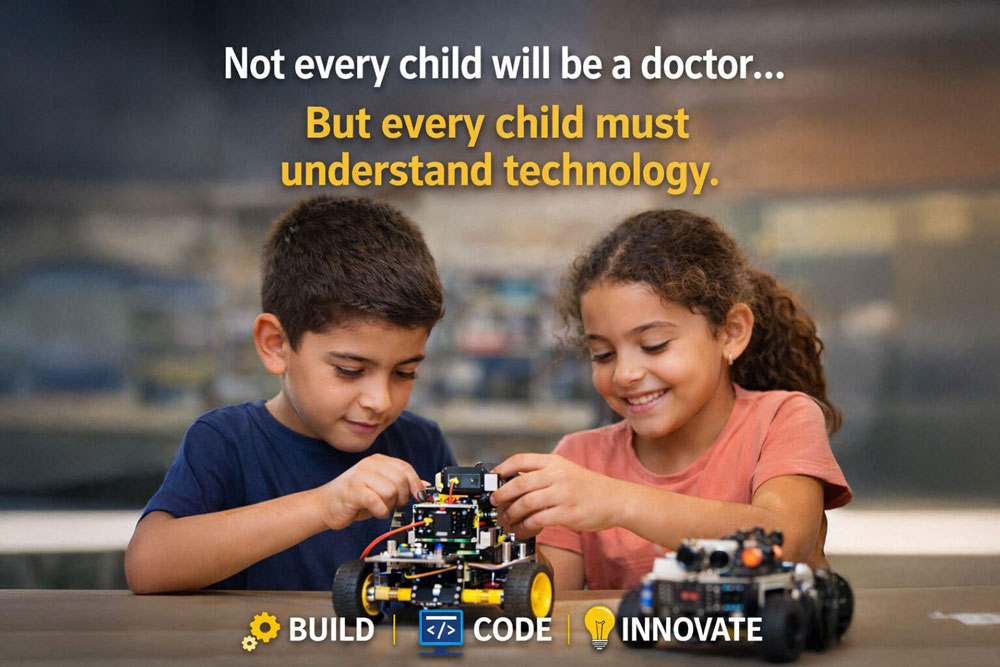
Not every child will choose the same career path — and that diversity of talent is exactly what a healthy economy needs. Some will become doctors, nurses, or healthcare professionals.Others will become engineers, technicians, AI specialists, creatives, educators, or entrepreneurs.Many will work in emerging fields such as eSports, gaming, robotics, automation, virtual reality, sustainable technologies, and AI-enabled industries.
What matters most is not which profession a child chooses, but whether we give them the digital understanding and mindset required to succeed in a technology-driven world.
Few sectors illustrate this transformation better than healthcare. Artificial Intelligence is already enhancing diagnostics, treatment, and efficiency. Advanced imaging technologies — such as MRI, CT, and PET scans — are no longer just machines that produce images. They are becoming intelligent systems that assist clinicians in making faster, more accurate decisions.
Global leaders like Siemens Healthineers have already deployed AI-powered reporting and analytics within scanning equipment. These systems:
This is not science fiction. It is happening today — in hospitals, clinics, and diagnostic centres across the world. The doctors of tomorrow will work with AI, not against it. And many of the professionals supporting healthcare — from technicians and data specialists to AI engineers — may never wear a white coat, yet will be essential to patient care.
Beyond health, technology continues to open new career pathways:
These careers demand more than technical know-how. They require problem-solving, creativity, adaptability, and ethical thinking — skills that must be nurtured from a young age.
Parents remain central to this transformation. They do not need to master technology themselves, but they do need to:
When parents are engaged, children feel supported. When parents understand the changing nature of work, children gain confidence in exploring new paths.
Equally critical are our teachers and educators. If our economy is evolving, then teaching methods must evolve too. Teachers today are no longer just transmitters of knowledge. They are:
Innovative teaching methods — integrating AI, digital tools, simulations, real-world challenges, and interdisciplinary learning — are essential if we want students to remain relevant in a fast-moving economy. This does not mean replacing teachers with technology. It means empowering teachers with the tools, training, and trust to innovate. A digitally confident teacher creates digitally confident students — and that confidence translates directly into economic resilience, productivity, and competitiveness.
Our responsibility — as parents, educators, and policymakers — is to prepare young people not for the world we grew up in, but for the world they will inherit.
A world where:
Not every child will be a doctor. But every child deserves the digital skills to shape their own future — in health, industry, creativity, and beyond.